Getting paid
Set payouts up before you list. Money settles into your own account on a rolling delay of about a week.
Two rails, chosen by where you are
- Card payouts
- A Stripe Express account in your name, opened through the app. Currently for sellers in the United States.
- Local payouts
- A Flutterwave account tied to your bank details, for Nigeria, Kenya, Ghana and South Africa. You pick your bank, enter the account number, and we check the name on it before anything is created.
Or skip us entirely: direct payouts
 1234
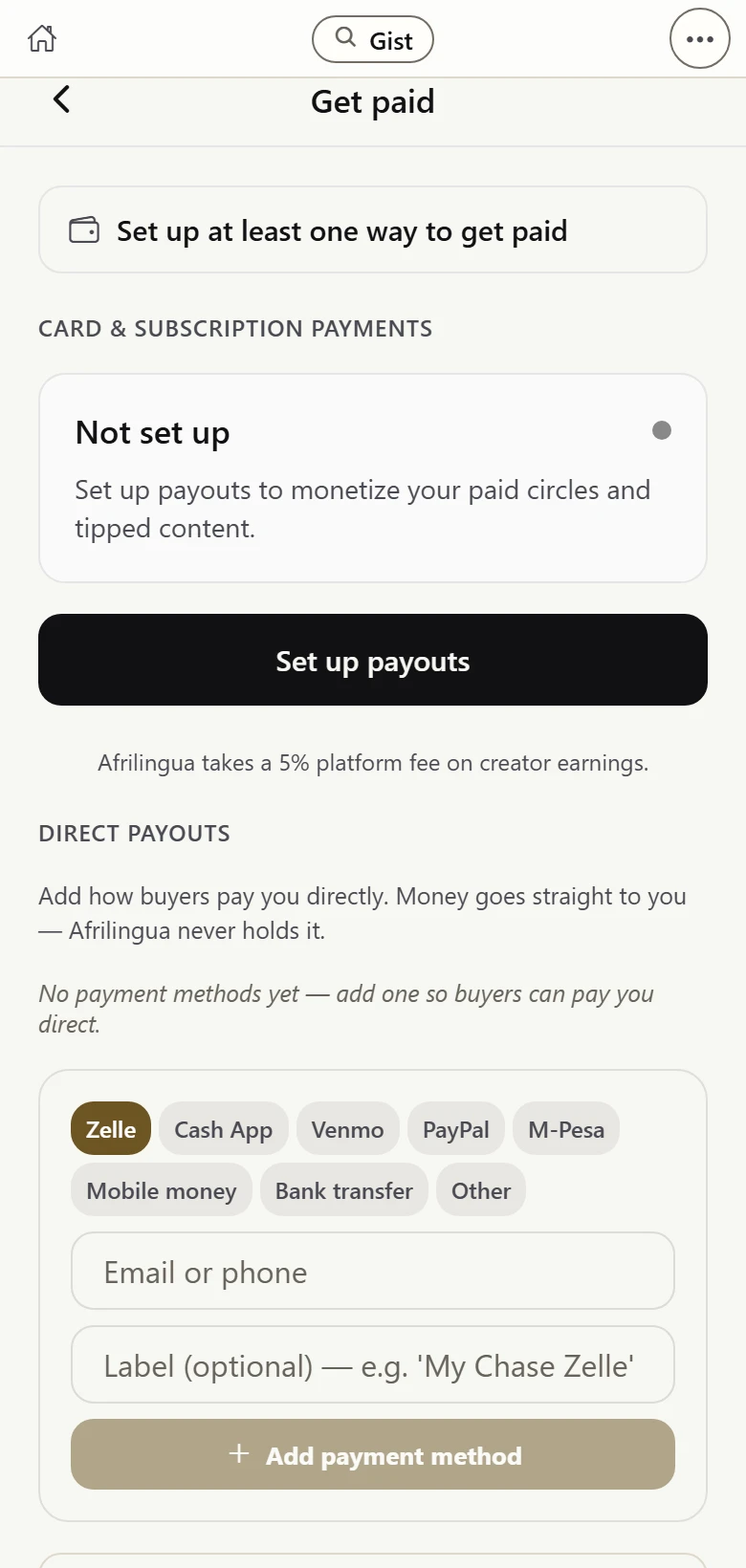
- The one line that matters: whether money can reach you at all. It reads across both rails, so a green here means you are genuinely payable.
- The card rail. Until this says otherwise you cannot list, because there is nowhere for a card payment to land.
- Direct payouts are the other way to be paid — the buyer pays you, and we never hold the money.
- Add a handle: Zelle, Cash App, Venmo, PayPal, M-Pesa, mobile money or a bank transfer.
You can also just tell buyers how to pay you. Add a payout handle and a buyer can settle with you directly — the money goes from them to you and never passes through us at all.
- What it costs
- Nothing. No platform fee, because there is no payment for us to be in the middle of.
- How it runs
- You agree a deal, your handle is revealed to that buyer, they pay you, and you both confirm. It shows up under Deals rather than Orders.
- Handles
- Zelle, Cash App, Venmo, PayPal, M-Pesa, mobile money, bank transfer, or something else you describe.
Card payments are the opposite trade: a fee, and a buyer who can be refunded through the product. Most sellers end up offering both and letting the buyer choose.
When the money arrives
Card payouts run daily on a seven-day rolling delay. A sale today is paid out about a week later, and then continuously after that.
The delay exists because a card chargeback can land well after a sale, and we carry that liability rather than pushing it onto sellers. Keeping funds in the account for a week means a clawback usually meets the money instead of an empty balance.
Ticket money is not held until the event
Worth saying explicitly for anyone selling tickets: the seven-day roll still pays you out before an event three weeks away. That is a cash-flow fact you can plan around, and also an obligation — the money is yours in advance of doing the thing.
One place that tells you the truth
The Get paid screen carries a single verdict across both rails: can money reach you right now, yes or no. Everything else on that screen is detail underneath that one answer.
If your account needs more information before it can be paid, that is where it says so and where you finish it. An unfinished setup blocks listing, so it is not a state you can sit in unknowingly.
Related
What it costs — every fee in one place
Five percent plus a small fixed amount on a sale, taken out of the seller's side. Delivery is priced separately and says so.
Handling orders
What each status means, what you owe at each one, and the clocks that move an order when nobody does.
Where it works, and what is still missing
An honest list of which countries, currencies and delivery methods are live — and which are not.